
.svg)



WORKDAY TALENT DEMAND ENTERS A NEW PHASE
Organizations are rethinking how they manage finance, HR, compliance, and data. That shift is accelerating demand for professionals who can implement, optimize, and secure enterprise platforms like Workday.
Labor projections from the U.S. Bureau of Labor Statistics (BLS) show strong growth across jobs that support Workday ecosystems. Roles tied to systems analysis, finance, HR, and cybersecurity are all projected to expand through the coming decade. This is reflective of broader digital-transformation priorities across industries.
The BLS indicates that business and financial positions are expected to grow faster than average through 2033. This growth is driven by increasing regulatory complexity, globalization, and data-driven decision-making.
At the same time, organizations face tightening labor markets for technical talent. The BLS indicates that demand for technology-focused roles continues to rise as companies modernize systems and automate processes.
WORKDAY INVESTMENT MOMENTUM
Workday enters 2026 with clear and sustained investment momentum across HR, Finance, and AI‑enabled capabilities. This is supported by subscription growth, expanded module adoption, and accelerated customer spending. The company’s FY25 financial results reinforce the depth of enterprise commitment to Workday. They show that organizations view it as a long‑term strategic platform rather than a transactional system of record.
Earnings data shows that Workday’s subscription revenue grew 16.9% year‑over‑year, reaching $7.7 billion. This indicates that organizations are renewing their contracts. Furthermore, they're expanding their footprint across modules such as HCM, Financials, Adaptive Planning, and newer Workday AI capabilities.
Workday’s total FY25 revenue climbed to $8.4 billion (+16.4%), underscoring broad enterprise adoption and continued investment in Workday-led digital transformation programs. This growth comes despite macroeconomic pressures that have slowed or paused implementations for other enterprise SaaS providers.
The steady increase in Workday subscription revenue suggests three key dynamics shaping the Workday talent market:
1. Expansion of Workday environments, not just maintenance
Customers are expanding into Financials, Planning, Prism, Extend, and Skills Cloud as they modernize HR and Finance architectures. Workday is now deployed at more than 11,000 organizations. This indicates a need for functional and technical specialists grows proportionally to the platform’s complexity and module adoption.
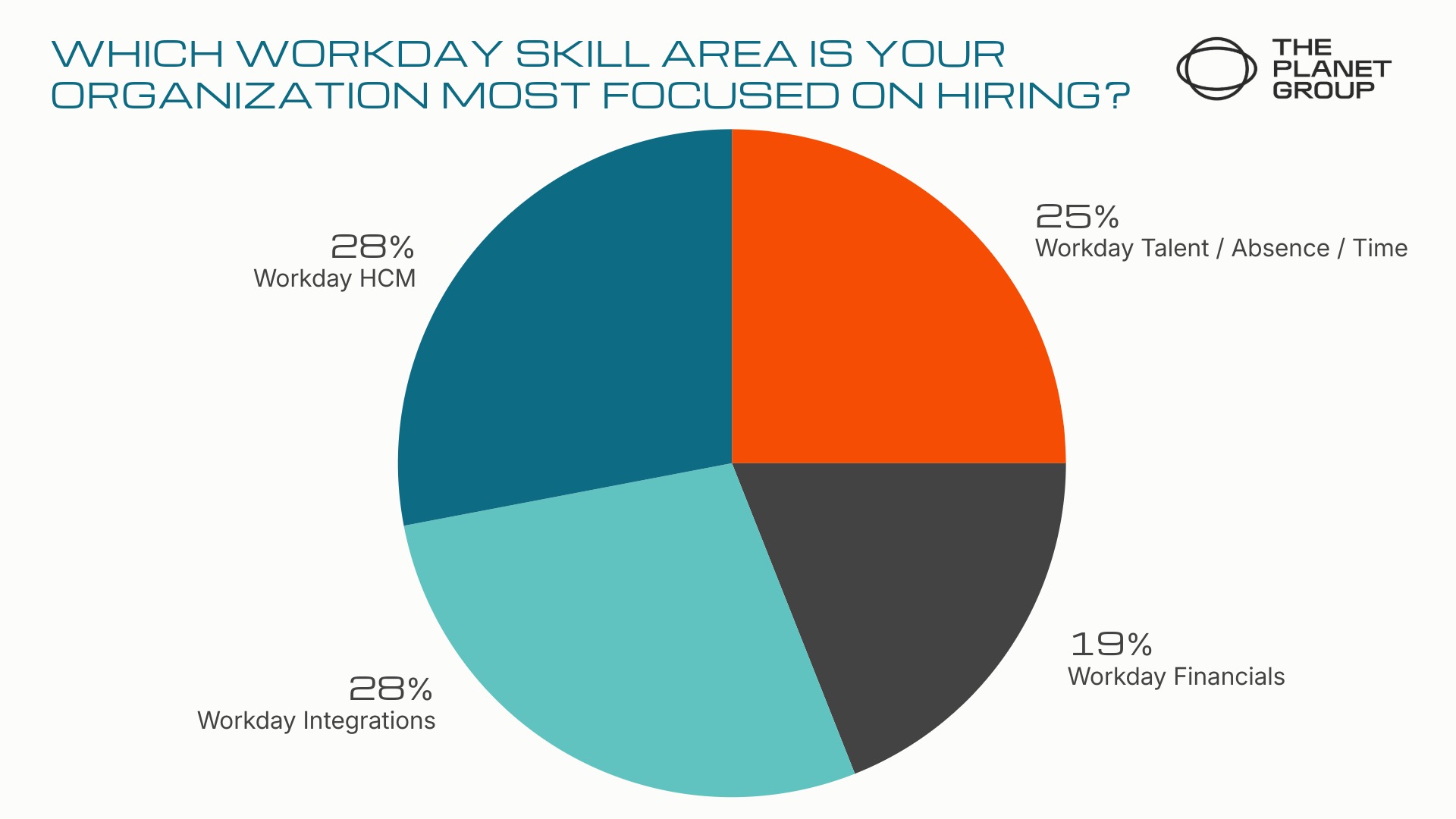
2. Higher demand for Workday specialists across functional, technical, and hybrid roles
As organizations scale their Workday environments, they need talent capable of sustaining and optimizing platform investments. This fuels demand for:
- Workday Administrators & Configuration Analysts – to sustain growing module footprints and optimize configurations.
- Functional HCM, FIN, and Talent Consultants – especially in Total Rewards, Recruiting, Absence, and Accounting Center.
- Integration Developers & Reporting Specialists – driven by cross‑platform integrations and the need to centralize enterprise data.
- Workday AI/Illuminate Specialists – a rapidly emerging role category created by Workday’s shift toward AI agent‑driven workflows.
3. Workday expansions drive long‑term staffing needs
Workday’s subscription‑based growth signals long-term system reliance, meaning customers increasingly invest in sustaining engineering, optimization teams, governance structures, and automation. These trends show that the Workday talent market will keep growing in 2026. It will also become more specialized and require stronger technical and functional skills.
WORKDAY'S AI STRATEGY IS RESHAPING REQUIRED ROLES & SKILLS
Workday’s AI transformation is reshaping the demand landscape for Workday talent dramatically. In a little over a year, Workday introduced multiple waves of AI Agents. These agents are designed to automate, accelerate, and augment HR, Finance, and enterprise workflows at scale.
These agent‑enabled capabilities push Workday into a new era of process automation. They also create the need for a different type of Workday workforce.
WHAT THIS MEANS FOR WORKDAY JOBS
AI Agents aren’t eliminating Workday roles, they’re elevating and transforming them.
Growing Role Categories
Organizations now need Workday professionals who can govern, optimize, and operationalize AI‑driven workflows:
- Workday AI/Illuminate Analyst: Designs, governs, and tests AI agent behavior; identifies opportunities for agent deployment.
- Workday Agent Governance Lead: Ensures safe, compliant, audit-ready use of AI agents; manages autonomy thresholds and risk controls.
- Workday Data Steward (Cross‑Module): Oversees data readiness, quality, lineage, and security; critical because agents depend on high‑quality datasets.
- Workday Process Automation Architect: Re‑engineers processes around AI agent capabilities; maps human vs. machine tasks.
- Workday Tenant Optimization Lead: Continuously tunes configurations, security, analytics, and workflow designs to maximize agent efficiency.
The Bottom Line
Workday’s AI strategy is grounded in AI agents and tenant‑embedded automation. It requires a workforce with deeper specialization, cross‑functional literacy, and data‑driven decision‑making skills. Organizations that use AI agents will need to hire, train, and reorganize around new Workday skill paths. This will help them get the most from their investment.
THE WORKDAY TALENT SUPPLY/DEMAND GAP IS WIDENING
The gap between the skills organizations need and the skills their Workday teams have is growing faster than leaders expected. Workday’s Global State of Skills research paints a clear picture of a talent ecosystem under pressure. Both HR and Finance leaders are increasingly concerned about their ability to build Workday‑enabled workforces. They worry about sustaining teams sufficiently equipped for AI‑driven transformation.
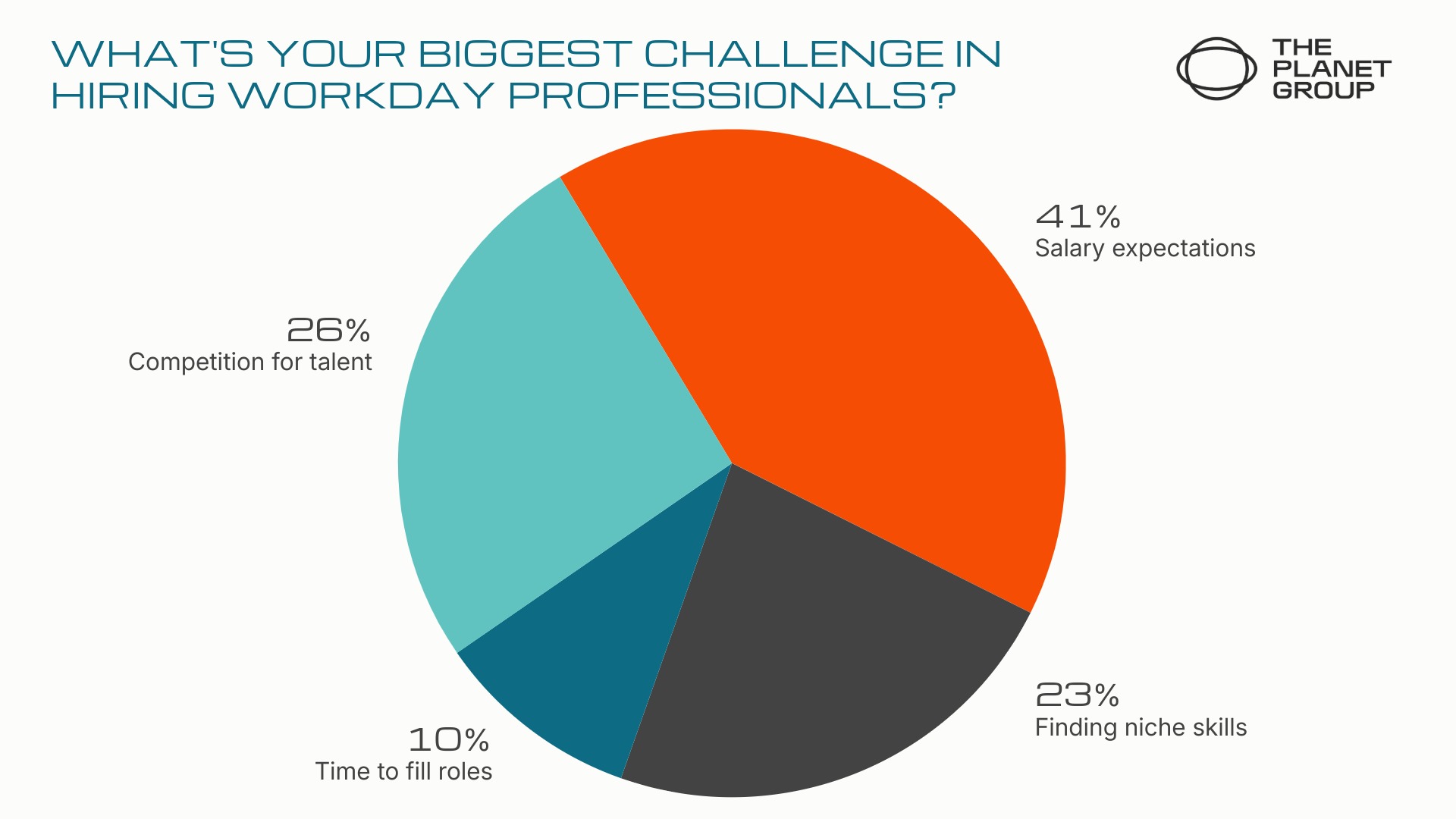
Workday’s Global Skills Data Reveals Increasing Workforce Risks
According to Workday’s global research, organizations are already confronting significant capability gaps:
- 51% of business leaders fear future talent shortages, pointing to rising demand for Workday expertise.
- Only 32% of leaders feel confident their workforce has the skills required for long‑term success. This reflects the rapid pace at which Workday’s platform and AI capabilities are evolving.
- 55% of organizations have begun shifting to skills‑based talent models. They're moving away from traditional job title‑based hiring in favor of capability‑first workforce strategies.
- AI adoption is accelerating specialization and widening gaps between generalist HR/Finance roles and next generation Workday technical roles.
This shift is creating a structural imbalance where demand for Workday talent is growing faster than the available supply. This is particularly true in analytics, AI, and Workday Financials.
MARKET OUTLOOK & KEY TRENDS
Enterprise Platforms Become Strategic Infrastructure
Organizations are moving beyond viewing HR and finance platforms as administrative tools. Federal IT modernization strategies emphasize enterprise data integration, governance, and analytics as core operational priorities.
The U.S. Department of Energy’s IT Strategy highlights enterprise platforms as foundational to secure, data-driven decision environments and cross-agency collaboration. Similarly, its Enterprise Data Strategy stresses unified data architecture and governance as prerequisites for advanced analytics and AI adoption.
For many organizations, Workday is central to this transformation. It elevates Workday roles from system support to strategic enablement. This drives demand for professionals who can optimize configuration, strengthen governance, and unlock advanced reporting capabilities.
HR Technology Investment Is Accelerating
Global investment in HR platforms continues to expand as organizations prioritize workforce analytics, automation, and employee experience. S&P Global Market Intelligence reports that HR tech spending is rising. Companies are modernizing talent tools and moving to cloud-based systems.
Quarterly industry research likewise shows organizations adopting advanced HR technologies to improve workforce planning, reporting, and compliance capabilities.
As companies expand capabilities in talent management, workforce planning, payroll, and embedded analytics, the need for Workday-certified professionals continues to grow. Investment in HR technology is about maximizing platform value, ensuring compliance readiness, and building scalable digital workforce strategies powered by Workday.
Compliance Pressures Are Expanding Platform Teams
Regulatory requirements are reshaping enterprise system staffing. The SEC’s cybersecurity disclosure rule requires public companies to report material cyber incidents and disclose risk-management processes. This is increasing demand for professionals who can manage system security, reporting workflows, and governance controls. The need is especially strong within enterprise platforms that serve as systems of record for financial and workforce data.
Financial compliance obligations also remain significant. A 2025 Government Accountability Office report notes that Sarbanes-Oxley compliance can create substantial reporting and internal-control costs. This reinforces the need for robust enterprise systems and skilled professionals to manage them.
For Workday customers, it also means ensuring the platform is properly configured. This helps support audit readiness, disclosure accuracy, and governance controls. As a result, demand is rising for talent who can align regulatory requirements with system architecture and reporting integrity.
EMPLOYMENT & WORKFORCE TRENDS
Roles Supporting Workday Ecosystems Are Growing
Several occupations that commonly align with Workday implementations and optimization are projected to grow:
- Information Security Analysts: projected much faster than average growth due to rising cybersecurity threats.
- Computer Systems Analysts: demand driven by organizations improving efficiency through technology.
- Financial Analysts: growth tied to demand for data-driven financial decision-making.
- Accountants and Auditors: continued need for compliance and financial transparency.
- HR Specialists: expansion fueled by workforce complexity and regulatory requirements.
The BLS fastest-growing occupations list also shows many technology-related roles among the fastest expanding nationwide. This reinforces the importance of digital skills in enterprise environments like Workday.

Our Most In-Demand Workday-Related Roles
The Planet Group connects organizations with a wide variety of talented individuals to assist with their Workday implementations. The following were the most in-demand Workday-related roles from our clients over the past year:
- Workday Payroll Consultant
- Workday Integrations Consultant
- Workday HCM Consultant
- Workday Financials Consultant
- Workday Reporting / Analytics Consultant
- Workday Benefits Consultant
- Workday Recruiting / Talent Management Lead
- Workday Project Manager
- Workday Architect
- Workday Analyst
These roles sit at the intersection of business operations and enterprise technology. This is precisely where organizations are investing most heavily.
Contract vs. Permanent Positions
When it comes to Workday implementations, contract work has led the requirements The Planet Group has received from clients.
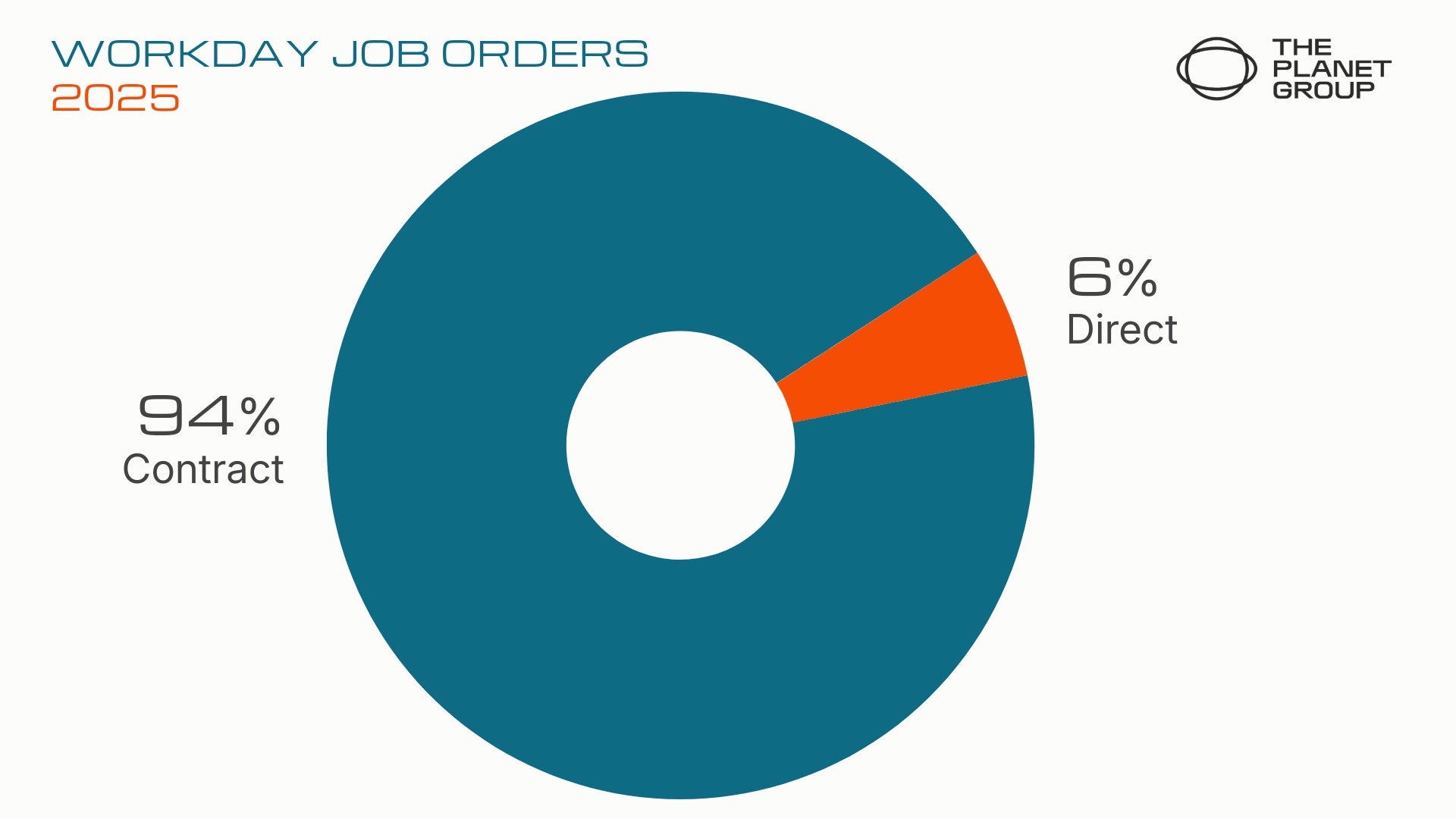
In 2025, 94% of all Workday-related hiring requests were for contract or contract-to-hire positions. This is only a marginal change over 2024, where 96% of these requests were for contract roles.
Remote vs. In Person Work
Return to office policies dominated the workplace in 2025, but Workday positions were a notable exception.
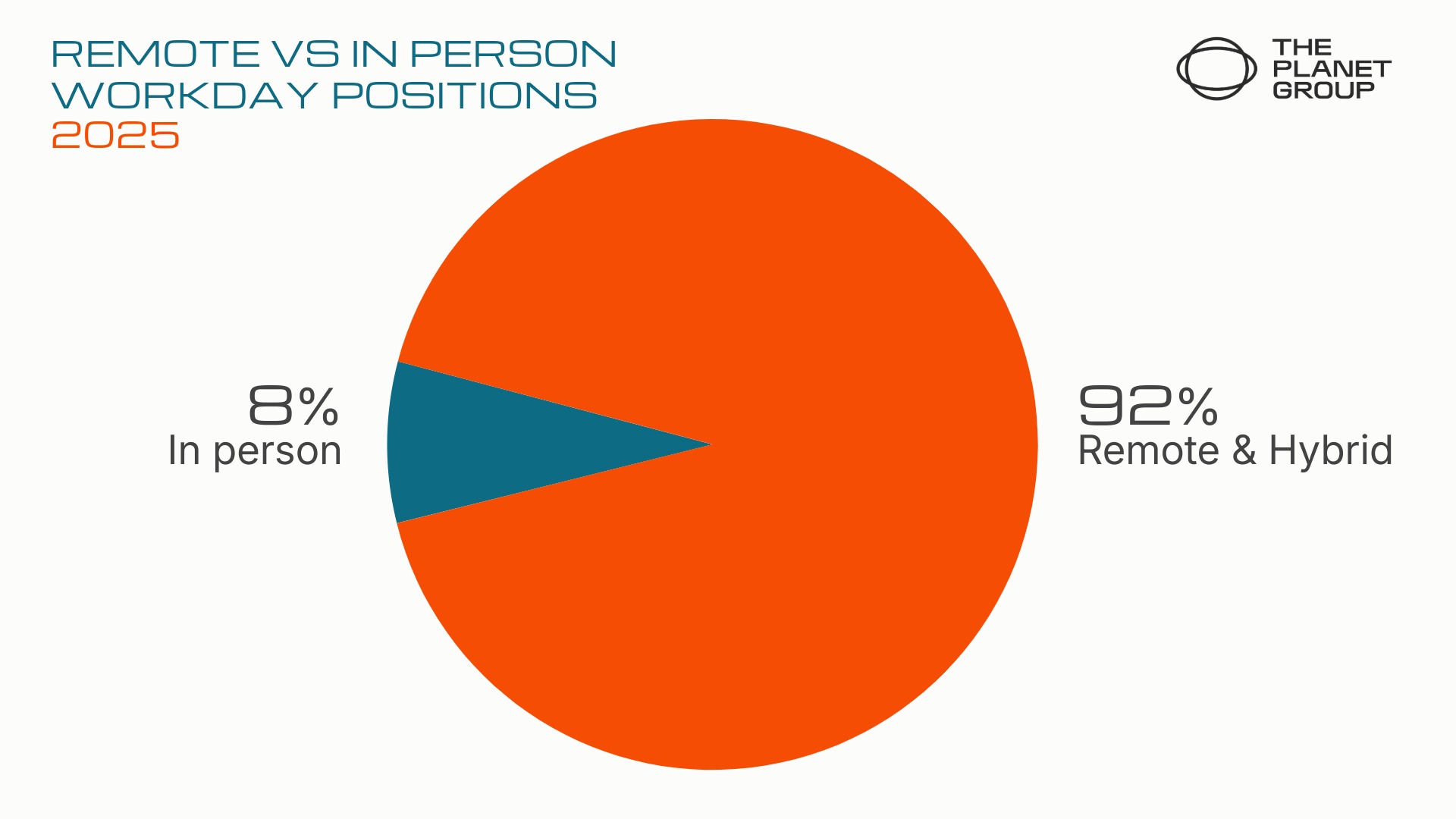
The number of Workday professionals working fully remote or hybrid increased to 92% in 2025, up from 88% in 2024. To attract the best Workday talent, organizations need to provide flexibility around remote and hybrid work options.
SKILLS & HIRING SHIFTS
Hybrid Business & Technology Talent Is in Demand
Organizations increasingly seek professionals who combine domain expertise with platform fluency. Workday-related hiring frequently targets candidates who understand HR, finance, or compliance processes alongside system configuration and data management.
National workforce projections show that technology adoption is reshaping occupational demand, with employers prioritizing analytical thinking, digital literacy, and systems knowledge.
AI Governance Is Becoming Essential
As organizations deploy AI-enabled analytics inside enterprise systems like Workday, governance and risk management capabilities are becoming core job requirements. The National Institute of Standards and Technology’s (NIST) AI Risk Management Framework emphasizes structured oversight, transparency, and accountability in AI deployment.
NIST further highlights the need for skilled professionals to evaluate model risks, monitor outputs, and implement safeguards. These responsibilities increasingly tied to enterprise platform teams.
LOOKING AHEAD
The future of Workday-related hiring will be shaped by organizations’ ability to integrate technology, compliance, and workforce strategy.
Enterprise platforms are becoming the backbone of modern business operations. The professionals who design these systems will play a strategic role. The same is true for those who secure, optimize, and analyze them.
Companies that invest early in skilled talent will have an advantage. Organizations that build strong platform expertise will be better prepared to adapt. They will also be able to scale and compete more effectively in the digital economy.
Still weighing your HCM options or ready to level up your Workday implementation? Maybe you're a Workday professional looking for your next opportunity. No matter where you might be in your Workday journey, reach out today and let's get a conversation started.
