
.svg)



Data centers have become critical infrastructure for the AI economy. As organizations expand cloud environments, deploy more AI workloads, and process larger volumes of data, the physical infrastructure behind those technologies must grow with them. That is creating demand not only for technology professionals, but also for the construction, engineering, electrical, project management, safety, and operations talent needed to bring new capacity online.
The scale of that expansion is becoming increasingly clear. The Lawrence Berkeley National Laboratory’s United States Data Center Energy Usage Report: 2025 Update estimates that data centers could account for 11.8% of total U.S. electricity consumption by 2030, with modeled scenarios ranging from 9.5% to 15.3%.
The Planet Group’s own data center hiring trends point in the same direction. Our hiring activity accelerated sharply in the first half of 2026, while the mix of roles became broader and permanent hiring gained ground. Together, these trends suggest organizations are building multidisciplinary workforces to support long-term infrastructure growth.
DATA CENTER INVESTMENT AND AI ARE DRIVING WORKFORCE DEMAND

AI is changing the scale and urgency of data center development. The International Energy Agency’s Energy and AI report projects that global electricity consumption from data centers will more than double by 2030, reaching about 945 terawatt-hours. In the United States, data center electricity consumption is projected to rise by roughly 240 TWh, or 130%, from 2024 to 2030. The IEA also expects data centers to account for nearly half of U.S. electricity-demand growth over that period.
Those numbers matter for the labor market because every increase in compute capacity requires more than servers. New facilities need sites, electrical systems, cooling, structured cabling, networking, security, commissioning, and ongoing operational support. They also rely on utility and power infrastructure that may sit well outside the walls of the data center itself.
This is why data center hiring increasingly touches several labor markets at once. Technology teams remain essential, but they are only one part of the workforce equation. Construction managers, electrical engineers, mechanical engineers, project leaders, electricians, safety professionals, network architects, and operations specialists all contribute to turning investment into usable capacity.
As the buildout continues, workforce planning will need to happen earlier. Organizations that secure capital, sites, and equipment without considering talent availability may still face delays when specialized skills are difficult to find.
DATA CENTER HIRING TRENDS SHOW ACCELERATING DEMAND
The Planet Group’s internal job-order data shows a clear acceleration in data center hiring activity. During the first half of 2026, data center-related job orders increased 80% year over year compared with the same period in 2025.
The pace of hiring is also notable when compared with the prior full year. By the end of June 2026, data center job-order activity had already reached 90% of the total volume recorded throughout all of 2025.
This growth was not limited to a single function. Hiring requests included construction managers, superintendents, engineers, network and cloud professionals, project and program leaders, safety specialists, and other roles supporting the development and operation of data center infrastructure.

The numbers should not be viewed as a measure of the entire U.S. market. They reflect hiring demand seen by The Planet Group. Still, these data center hiring trends align with the broader infrastructure expansion happening across the industry. More facilities, higher power demand, and more complex technology environments are creating more points at which employers need specialized talent.
For employers, the implication is straightforward: hiring needs may rise faster than internal recruiting capacity, especially for positions requiring both technical expertise and experience in mission-critical environments. Survey responses reinforce that challenge. Qualified talent shortages and compensation mismatches were identified as the two most common factors delaying data center hiring.
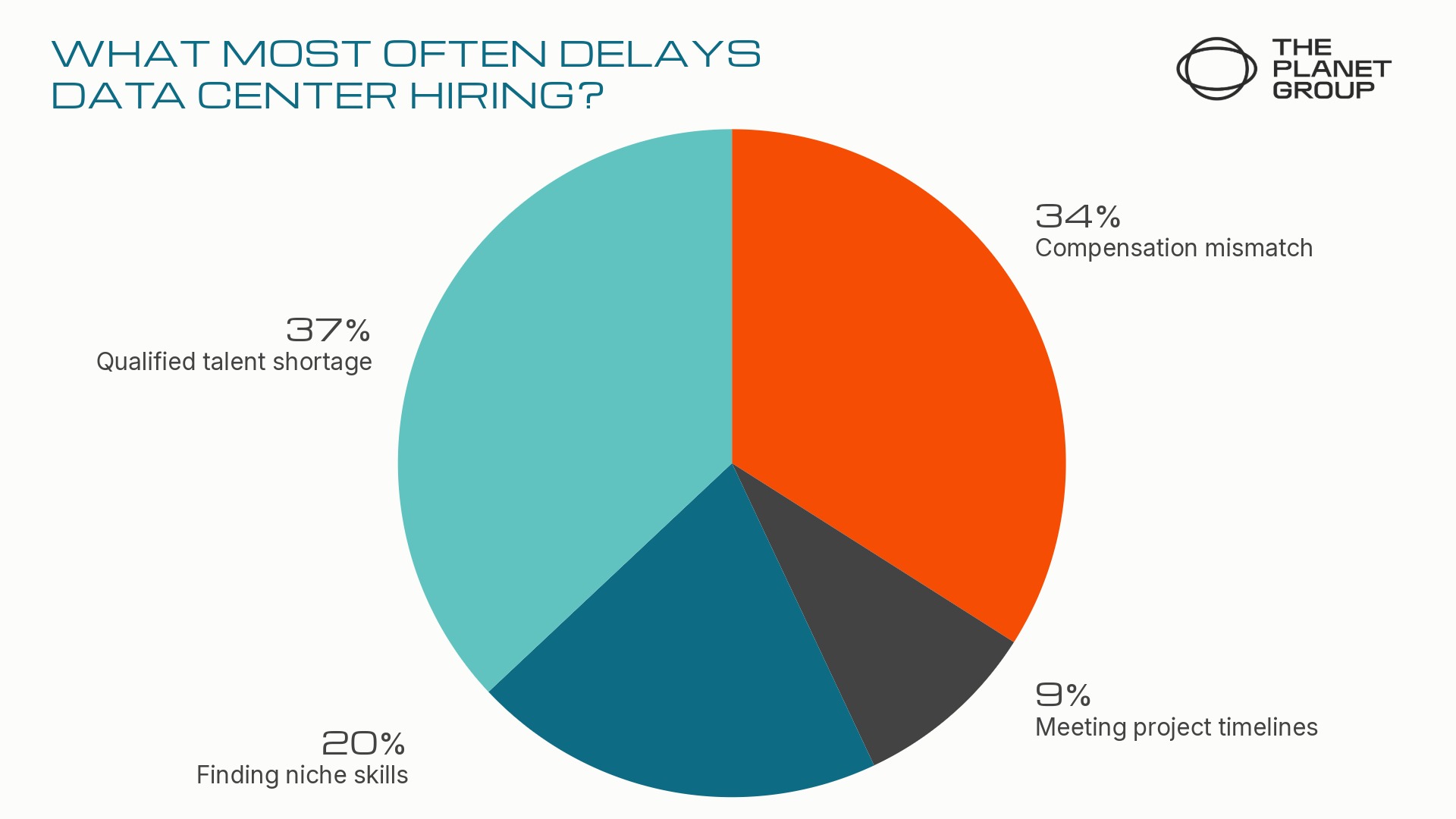
Taken together, 91% of respondents pointed to talent availability, specialized skills, or compensation as the primary source of hiring delays. That suggests the data center talent shortage is not driven by a single issue. Employers are balancing competition for qualified professionals, increasingly specialized requirements, and compensation expectations while trying to keep projects moving.
DATA CENTER JOBS SPAN THE FULL INFRASTRUCTURE LIFECYCLE
There is no single “data center workforce.” The Planet Group’s hiring activity shows demand across the full lifecycle, from construction and engineering through technology infrastructure and ongoing operations.
Survey results also show how varied that demand can be. IT and networking accounted for the largest share of the backgrounds employers said they were hiring most, but engineering, operations, electrical, mechanical, construction, and field service talent all remain part of the workforce mix.
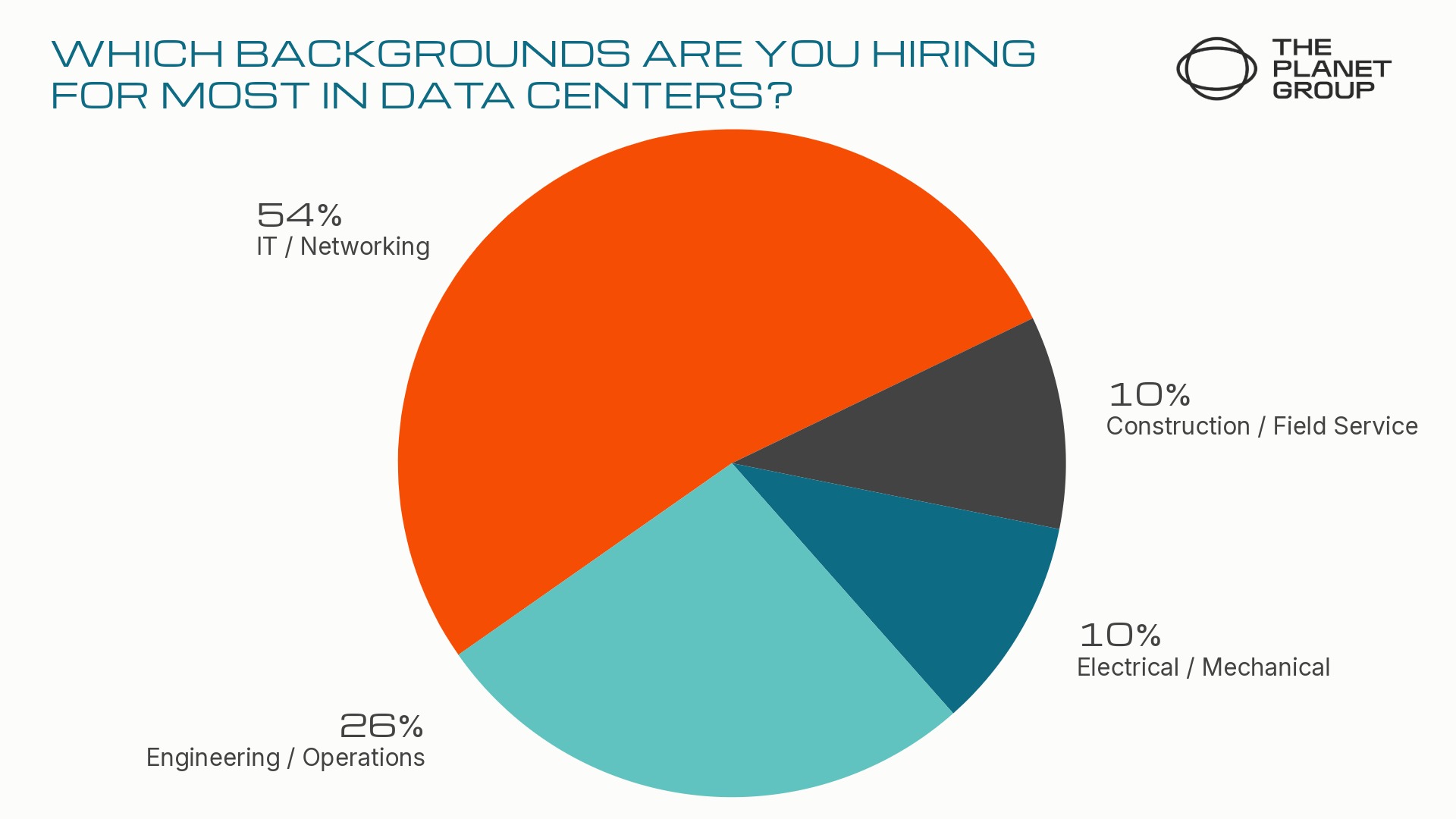
That breadth is also reflected in The Planet Group’s hiring activity.
Construction-related roles include construction managers, superintendents, project managers, planners, and schedulers. Engineering demand spans electrical, mechanical, civil and structural, and fire-protection expertise. Technology hiring includes network engineers and architects, cloud professionals, systems engineers, and other infrastructure specialists.
Project and program leaders are also critical. Data center projects involve coordination across owners, contractors, engineers, equipment vendors, utilities, technology teams, and business stakeholders. The more complex a project becomes, the more valuable professionals are who can translate between these groups and keep schedules, budgets, and technical requirements aligned.
National labor projections reinforce the importance of many of these occupations. The U.S. Bureau of Labor Statistics projects construction manager employment to grow 9% from 2024 to 2034, with about 46,800 openings per year. Electrician employment is also projected to grow 9%, with about 81,000 openings annually over the decade.
Engineering and technology roles show similar pressure. BLS projects employment of electrical and electronics engineers to grow 7%, with approximately 17,500 openings per year. Computer network architects are projected to grow 12%, with about 11,200 openings annually. BLS specifically notes that AI investment and continued cloud expansion are expected to increase the need for organizations to design, build, and upgrade IT networks.

Information security is another important part of the picture. BLS projects employment of information security analysts to grow 29% from 2024 to 2034, with about 16,000 openings per year.
These BLS projections cover the broader U.S. economy, not data centers alone. That distinction matters. Data center developers and operators are competing for many of the same skilled professionals needed by utilities, construction firms, manufacturers, technology companies, and other industries. This competition is one of the most important data center workforce trends to watch as infrastructure investment continues.
PERMANENT DATA CENTER HIRING IS GAINING GROUND
Flexible talent remains important in data center development, particularly when organizations need specialized expertise for a specific stage of a project. However, The Planet Group’s hiring data shows a noticeable shift toward permanent hiring.
In the first half of 2025, 15% of data center job orders were direct hire or permanent positions. In the first half of 2026, that share increased to nearly 42%.
That change does not mean contract hiring is disappearing. Data center programs move through distinct phases, and organizations often need to scale teams quickly around design, construction, implementation, commissioning, and other project milestones.
Instead, the increase in permanent hiring may signal that more employers are building long-term internal capability as data centers become a sustained part of their infrastructure strategy.
Contract and consulting talent can provide speed, flexibility, and access to hard-to-find expertise. Permanent employees provide continuity, institutional knowledge, and ownership over infrastructure that will need to be managed and optimized for years.
For many employers, the strongest approach will likely involve both. Workforce plans may need a core permanent team supported by specialized flexible talent as projects expand, timelines shift, or new technical requirements emerge.
ENERGY INFRASTRUCTURE IS EXPANDING THE DATA CENTER TALENT POOL

As data center development accelerates, employers increasingly need expertise that extends beyond the facility itself. Supporting new capacity can require professionals with backgrounds in power generation, electrical infrastructure, utilities, construction, and energy project delivery.
The U.S. Department of Energy is already connecting workforce development to this need. In May 2026, DOE announced up to $11.3 million in funding for regional energy workforce training programs. Eligible areas specifically included power generation for data centers, construction related to supporting infrastructure, and the technologies needed to enable that development.
For employers, this broadens the competition for talent. Electrical engineers, electricians, construction professionals, energy project managers, and power-generation specialists may be needed across data center projects while also being sought by utilities, energy companies, manufacturers, and other infrastructure-intensive industries.
That overlap could further contribute to the data center talent shortage, particularly in fast-growing markets. Employers may need to identify energy and infrastructure skill requirements earlier, expand recruiting into adjacent industries, and build talent strategies that account for both the facility itself and the power infrastructure required to support it.
WHAT IS ATTRACTING TALENT TO DATA CENTER CAREERS?
As hiring expands, employers also need to understand what draws professionals to the sector. Survey responses suggest that the appeal of data center careers is distributed across several factors rather than being driven by compensation alone.
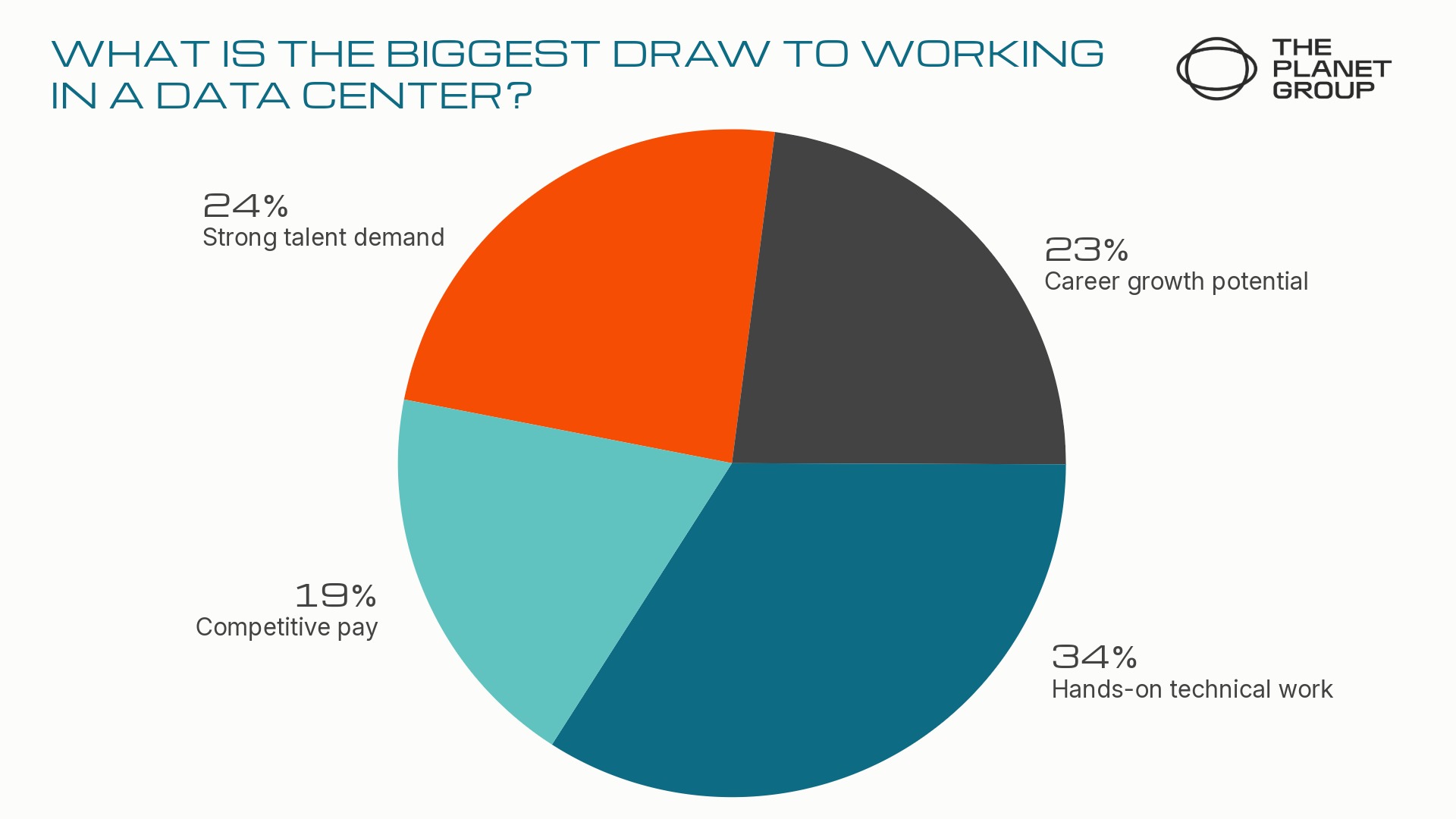
For employers, this creates an opportunity to think beyond salary when positioning roles to prospective candidates. While compensation remains important, particularly given the hiring challenges highlighted earlier in the report, recruiting messages should emphasize the technical nature of the work, exposure to rapidly expanding infrastructure, and opportunities to grow into more specialized or leadership-oriented positions.
These factors may become particularly important as employers recruit professionals from adjacent industries who have transferable construction, engineering, energy, networking, or operational experience but have not previously considered a career in data centers.
TALENT IS BECOMING PART OF THE CAPACITY EQUATION
Data center development moves quickly, but not every piece of supporting infrastructure can move at the same pace.

The IEA notes in its analysis of AI-related energy demand that a data center can become operational in two to three years, while the broader energy system often requires longer lead times for planning and construction. That mismatch is creating additional pressure around power availability and supporting infrastructure.
Workforce availability creates another potential bottleneck.
A data center project depends on a sequence of interconnected capabilities: site development, power, construction, equipment installation, connectivity, commissioning, security, and operations. A shortage of the right expertise at one phase can slow the work that follows.
For that reason, talent planning should be considered alongside site selection, power strategy, equipment procurement, and construction scheduling. Employers may need to identify critical roles months before they expect those professionals to start. They may also need to determine which skills should exist permanently in-house and which can be accessed through contract or project-based talent.
As data center hiring trends continue to accelerate, the organizations that treat workforce planning as part of capacity planning will be better positioned to respond.
LOOKING AHEAD
Data center growth is creating a workforce challenge that extends beyond simply adding headcount. As projects become larger and more complex, employers need specialized talent across construction, engineering, energy, technology, and operations. And they need those skills at the right stage of development.
These data center workforce trends also point to a need for more flexible talent strategies. Organizations may need to balance permanent employees who provide long term continuity with specialized contract talent who can support specific project phases, address skill gaps, and help teams scale as demand changes. Waiting until a project is underway to address critical hiring needs could make already complex timelines more difficult to manage.
Looking ahead, organizations that align talent strategy with infrastructure planning will be better positioned to move projects forward, adapt to evolving requirements, and support data center capacity well beyond initial construction.
Whether you are building new data center capacity, expanding existing infrastructure, or preparing for ongoing operations, The Planet Group can help you find specialized talent across engineering, energy, construction, technology, and business functions. Reach out today to start a conversation about your workforce needs.
